Elizabeth Hartline Green
Where do the candidates stand on education? Ron Paul on education.
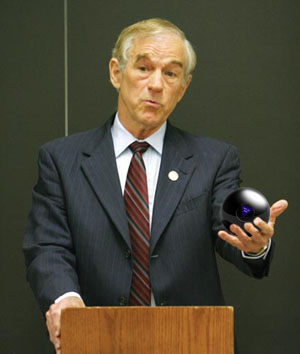
This is the third in an ongoing series on where the candidates stand on education.
Today, we will examine the educational record and stances of Congressman Ron Paul.
Ron Paul has said markedly less than the other candidates about education; his website does not mention the word education or his stance on education issues. Nevertheless, he has made public statements about and voted for educational issues that reveal his beliefs about education policy.
Most of Paul’s educational stances come from his stance against federal involvement in education. In fact, all of his views stem from this, making him appear the most ideologically consistent candidate I have yet seen. He supports the abolishment of the Federal Department of Education, and wants parents to have complete freedom in how to educate their children. Paul voted against mandating prayer in public schools, but also against preventing it—essentially he just wants the federal government out of the issue. He also voted against authorizing No Child Left Behind, believing it represented too much federal involvement in education.
Ron Paul is strongly in favor of school choice, in his case defining school choice as parents have complete freedom of how to educate their children, and providing educational tax credits for all families with children. This plan, which he has proposed in 1997, 2001, 2003, 2005, and now 2007, has been repeatedly put forward in a bill that would provide $5000 yearly in tax breaks to every child who incurs educational expenses. The money is intended to compensate parents for educational expenses incurred, most likely at private schools (though I believe the credit would also apply to parents whose children are homeschooled, and possibly for some students in public school). Paul did not propose cutting public school funding in accompaniment to this bill, allowing him to put it forward as what he perceives a more favorable alternative to vouchers (which traditionally take money from public schools and apply them to private school tuition). These tax credit would prove most beneficial to families with higher incomes, as families of limited means do not pay much in income taxes.
Paul is not opposed to vouchers, though, and has voted to allow states to use federal money for school vouchers. Conversely, he voted not to establish a federal voucher program for students in Washington, D.C. This could possibly be because the D.C. program would represent a greater deal of federal involvement in schools, while the national program would use money already being provided to states for voucher; Paul has not explained the differences in these votes, though.
Paul is also for raising teacher salaries, in a roundabout way. Paul proposes a $1000 a year tax credit for all teachers in his tax credit bill. The interesting aspect of Paul’s support of tax credits is, while he is correct in asserting that they will not increase federal spending, they most certainly will decrease federal revenue, which seems to be a difference only of semantics. There are approximately 53 million school-aged children in the United States, and roughly 10% are in private school (a much smaller, but growing, number is homeschooled, which we will leave out of this calculation). If each of these children was given a $5000 tax credit, approximately $25 billion less would be raised in tax revenues every year. If we assume a teacher:student ratio nationwide of approximately 15:1 (which probably is a bit high, as other educators may be counted in the tax credit), we have another 3 billion dollars gone from the education budget (and thank you to Raymond, for catching a math error I made in the original post). This would almost equal the federal government's entire contribution to public education. Granted, this is a simple back-of-the-envelope calculation, so the actual amount may vary slightly, but it is startling. Paul also supports the abolishment of the IRS, which could explain this stance.
There is a lot of speculation that Ron Paul would end public education, but he has never actually said that is what he wants to do (though it certainly is a popular belief amongst libertarians). Essentially, Ron Paul’s educational stance seems to be a complete abolishment of any federal role in education, in favor of a larger role of parents and localities in school policy.
Elizabeth Hartline Green: Author Bio | Other Posts
Posted at 7:00 AM, Aug 09, 2007 in Candidates on Education | Education
Permalink | Email to Friend | Comments (9)


Comments
I just wanted to thank you for the depth of research (and understanding) provided in this article of a candidate whom some wish to disparage by misrepresenting his stance. From a fan of Ron Paul, I thank you earnestly for the accuracy of your writings.
Posted by: Joel | August 9, 2007 03:52 PM
I found an article online about a prospective Ron Paul presidency, and as this article is closely related, I figured I'd share. Pretty funny stuff. :)
http://www.somethingawful.com/d/news/google-ron-paul2.php
Posted by: fasmith718 | August 9, 2007 04:33 PM
"approximately $25 TRILLION less would be raised in tax revenues every year"
Umm we have a national GDP of $13 trillion dollars so I suspect your number is wrong. In fact it is
5000 * 53000000 = 265000000000 or $265 billion ( you were only off by times 1000 :O ).
"The interesting aspect of Paul’s support of tax credits is, while he is correct in asserting that they will not increase federal spending, they most certainly will decrease federal revenue, which seems to be a difference only of semantics"
This is not a difference in semantics. One results in higher taxes one results in lower taxes. One will make the government bigger, one will make the government smaller.
Posted by: Raymond | August 9, 2007 05:05 PM
You are completely right--I changed it in the article. That's the problem with calculators on the computer, the zeros are hard to count. I actually thought that sounded very large, but it still constitutes a great deal of money. So sorry for the mistake.
Cutting tax revenue without decreasing funding to public education (which is the current plan) isn't proposing to decrease the federal government--simply to cut tax revenue without a plan for where the money lost will come from. Were Paul to be elected and cut the DOE, this may be a logical step, but as that bill is currently NOT on the table, we are faced with a very different situation.
Posted by: Elizabeth Hartline Green | August 9, 2007 05:56 PM
Ron Paul wants to end Federal government interference in public education, NOT public education. Educating our children should be left to parents and state/local governments.
He makes this point clearly in the Q&A section of his Google interview: http://www.youtube.com/watch?v=yCM_wQy4YVg
BD
Posted by: Barry Day | August 9, 2007 09:38 PM
Oh, and how could I forget -- the best source of information for Congressman Paul's position on issues (including education):
http://www.ronpaullibrary.org/topic.php?id=13
Posted by: Barry Day | August 9, 2007 09:49 PM
The article was great. I love seeing someone addressing the facts and issues. Without complaining about no media support... Its up to us to get him elected.
The beauty of his plan is that freedom.. real freedom is whats best for our country. The Government shouldnt be making educational decisions for us. We should be independant and determining our future.
That idea. Once its planted and you realize you dont need the Government in your life in many ways. Thats freedom. We have been divided by terms from Government and the freedom message is opposite. It is bringing us together.
He stands as strong if not stronger than our fore fathers. I could not imagine being a 71 year old, after naysayers for 20 years and still boldy seeking justice for Americans.
The facts speak for themselves and so do the voting records. In a time when every politician played games with our future there is one sole Republican that understood the direction we were headed and tried his best to stop it.
You point me to a better man to run this country and Ill pay you $1000.00
I dont mean to be so bold. I just havent found one single reason not to vote for Dr. Paul. Ive found a million with the rest. He has it spot on. A true American Patriot.
Posted by: Parke Nicholson | August 9, 2007 10:25 PM
First, thanks for the link! I'll return the favor.
This is a great article - it's fair and informative. I just wanted to point out a couple of things though.
You stated "These tax credit would prove most beneficial to families with higher incomes, as families of limited means do not pay much in income taxes." I could be wrong, but I don't believe that's true. A tax credit can pay out even if you pay nothing in. For instance, the Earned Income tax credit does exactly that. While it is possible to limit a tax credit to no more than the tax you pay in, I haven't seen anything like that in the versions of the The Family Education Freedom Act that I have read.
Also, regarding the difference between increasing spending and decreasing revenue, one is money going out, while the other is money going in. Now while theoretically they should be tied together, in the federal government, that's not quite true. The government has a pretty long history of spending more - sometimes LOTS more - than it brings in. In my personal opinion, you HAVE to control spending if you are to consider yourself fiscally responsible. Trying to balance the Federal budget only from the income side is like trying to balance your personal budget by working longer hours while your family is maxing out your credit cards and getting a third mortgage on the house.
Posted by: Daniel | August 10, 2007 12:34 PM
Thanks for the article! In my opinion, Paul has a lot of ideas that can contribute to improvement of the level of education in our country. However, to me ending public education seems unreal and even unneccessary...
Posted by: Andy, school teacher | August 29, 2007 06:01 PM